

story 10 of 13


Dr. Crystal Senko
Professor, Department of Physics and Astronomy
Faculty of Science
Institute for Quantum Computing
Co-founder, Open Quantum Design
Building the world’s first open-source quantum computer
And a new model for how quantum research is shared — opening doors for the next generation and seeding new quantum startups
Researchers from the University of Waterloo's Faculty of Science and the Institute for Quantum Computing (IQC) are prioritizing collaboration over competition to advance quantum computer development and the field of quantum information. They are doing this through Open Quantum Design (OQD), a non-profit organization that boasts the world's first open-source, full stack quantum computer.
OQD was co-founded in 2024 by faculty members in the Department of Physics and Astronomy and IQC, Drs. Crystal Senko, Rajibul Islam and Roger Melko, alongside CEO Greg Dick (BSc ’93).
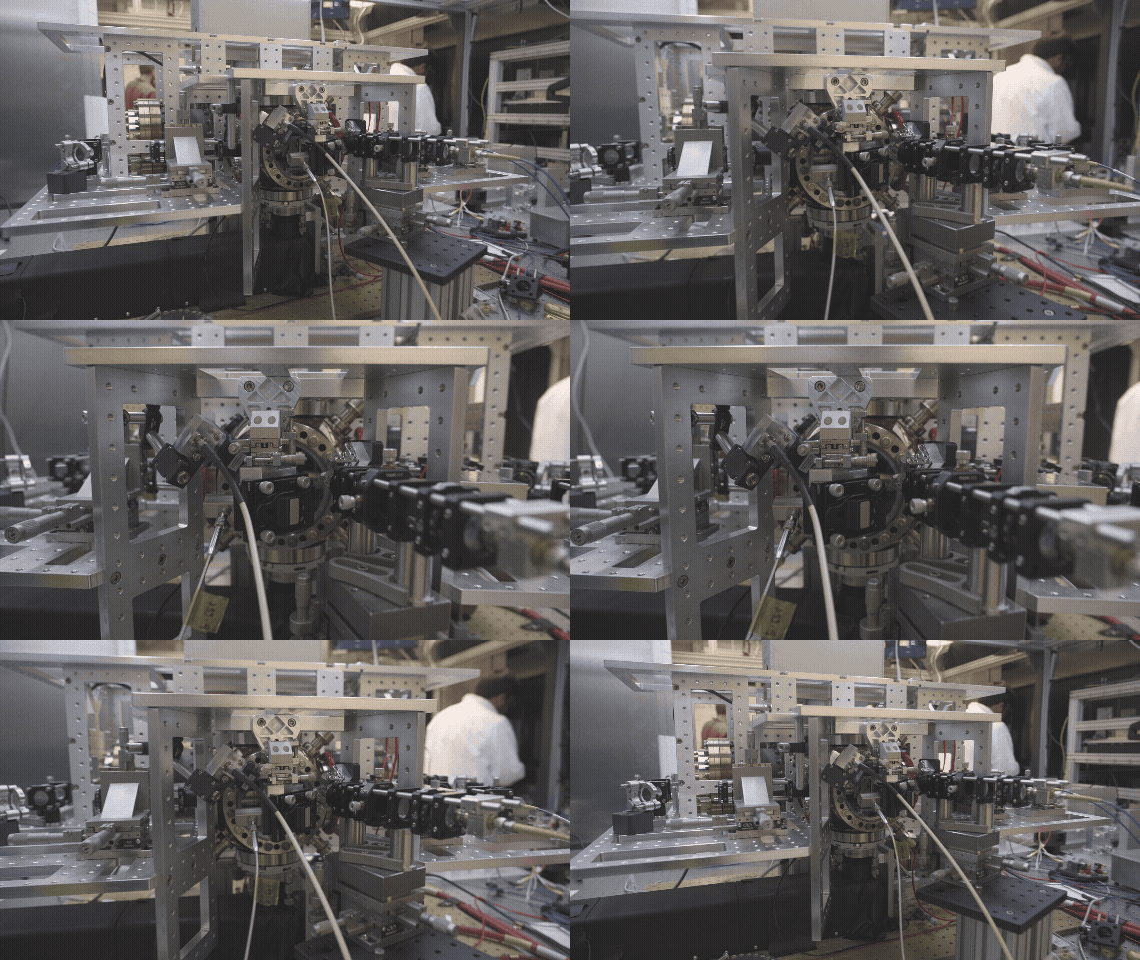
“We are offering a shared hub where groups can contribute what they’re comfortable sharing and, as a non-profit, we can be transparent about real progress without commercial pressures,” Senko says. OQD’s stack spans hardware, the electronic and computing layers that run it, and open software. Their quantum computer uses ion-trapping, which involves isolating charged atoms (ions) in a vacuum and manipulating them with lasers and electromagnetic fields. This isolation allows the atoms to act as quantum bits (qubits), storing and processing information with carefully controlled interactions. “Real hardware access is essential for developing and testing quantum algorithms,” Senko says. “OQD makes that access open, inviting broader participation and helping the community build faster on shared foundations instead of starting from scratch.”


The University of Waterloo acknowledges that much of our work takes place on the traditional territory of the Neutral, Anishinaabeg, and Haudenosaunee peoples. Our main campus is situated on the Haldimand Tract, the land granted to the Six Nations that includes six miles on each side of the Grand River. Our active work toward reconciliation takes place across our campuses through research, learning, teaching, and community building, and is co-ordinated within the Office of Indigenous Relations.

